
Proxy Knowledge
Application of Residential Proxies in Ad Verification for Global Digital Marketing Campaigns

Table of contents
A Breakthrough Strategy in Protecting Global Advertising Budgets
In the digital era, global Digital Marketing campaigns require massive financial investments. However, along with the growth of the online advertising industry comes an explosion of sophisticated fraud tactics. Ad Fraud not only wastes billions of dollars in corporate budgets annually but also distorts analytics data, severely impacting marketing strategies. To address this challenge, the Ad Verification process has become an indispensable step. Among these solutions, leveraging residential proxy marketing is considered the gold key for marketers to verify campaign transparency with maximum accuracy.
The Ad Fraud Landscape and the Challenges for Marketers
 Ad fraud tactics like ad stacking and hidden pixel stuffing stealthily drain digital marketing budgets without user visibility.
Digital ad fraud occurs in many complex forms. Bad actors or low-quality Ad Networks may use various tricks to exploit advertisers' budgets. Common forms include:
- Click Fraud: Using botnets or automated websites to click on ads in order to drain CPC (Cost Per Click) budgets.
- Ad Stacking: Stacking multiple ads on top of each other in a single ad unit. Users only see the top ad, but all hidden ads underneath are counted as impressions.
- Pixel Stuffing: Inserting ads into a tiny 1x1 pixel frame, making them invisible to users while the system still records impressions.
- Geo-masking: Serving impressions from low-cost countries while charging rates based on high-CPM target markets.
- Domain Spoofing & Cloaking: Displaying ads on sites that violate community standards or malicious networks while reporting them as impressions on reputable news sites.
When advertisers attempt manual checks or use standard scanning tools, fraudsters often detect the IP addresses of these tools and engage in "Cloaking"—showing valid content to the auditing tool while continuing to serve fraudulent content to real users. This requires businesses to adopt a professional ad verification proxy solution to see exactly what end-users are seeing.
Why Residential Proxies Are the Top Choice for Ad Verification
To inspect ads effectively, your monitoring system must act like a regular internet user in a specific country, city, or territory. This is why residential proxy marketing far outperforms traditional Datacenter Proxies.
1. Real Residential IPs
Unlike Datacenter Proxies whose IPs originate from data centers—making them easy to detect and block by anti-bot systems—Residential Proxies own IPs provided by actual Internet Service Providers (like VNPT, Viettel, AT&T, Comcast, Vodafone). Ad fraudsters cannot differentiate traffic coming from an ad verification proxy system from real users.
2. Geo-Targeting Precision
A global ad campaign might target customers in a specific city in the US, France, or Japan. With a residential IP-based ad verification proxy solution, you can select precise IP addresses down to the country, state, or even ZIP code. This enables marketers to check whether ads are displaying correctly to the targeted geographic audience.
3. Avoiding Blockades and Cloaking Detection
Fraudsters often build highly sophisticated bot detection systems. If they detect access requests originating from a datacenter IP, they will immediately redirect to a clean page. Using Residential Proxies eliminates automation footprints, bypasses anti-bot firewalls, and exposes cloaked fraudulent content.
Real-World Applications of Residential Proxies in Ad Fraud Detection
Integrating click fraud prevention proxies and ad verification systems brings many practical benefits to enterprises running large-scale marketing campaigns.
Ad Placement Compliance Verification
Marketers need to ensure their banner or video ads appear in the agreed positions on publisher websites. By using an ad verification proxy, businesses can automatically access thousands of target websites across different geographical regions to capture actual screenshots, verify banner dimensions, and inspect placement positions without publishers detecting the audit.
Detecting and Preventing Click Fraud
Click fraud is one of the biggest threats draining marketing budgets. When suspecting a partner network of generating fake clicks, businesses can use a click fraud prevention proxy paired with analytics tools to trace traffic paths and verify whether clicks come from real human behavior or automated scripts.
Ensuring Brand Safety
No major brand wants its ads appearing next to violent, gambling, adult, or fake news content. Using an ad verification proxy helps Brand Marketing teams continuously scan ad placements worldwide, timely detecting brand safety violations to request immediate removal or adjustment from partners.
Ad Funnel Verification
Beyond checking impressions and clicks, Residential Proxies also support auditing the entire landing page funnel. Businesses can verify if ad links in each country are misdirected, broken, or injected with malicious third-party tracking scripts.
Comparing Residential Proxies and Datacenter Proxies in Ad Verification
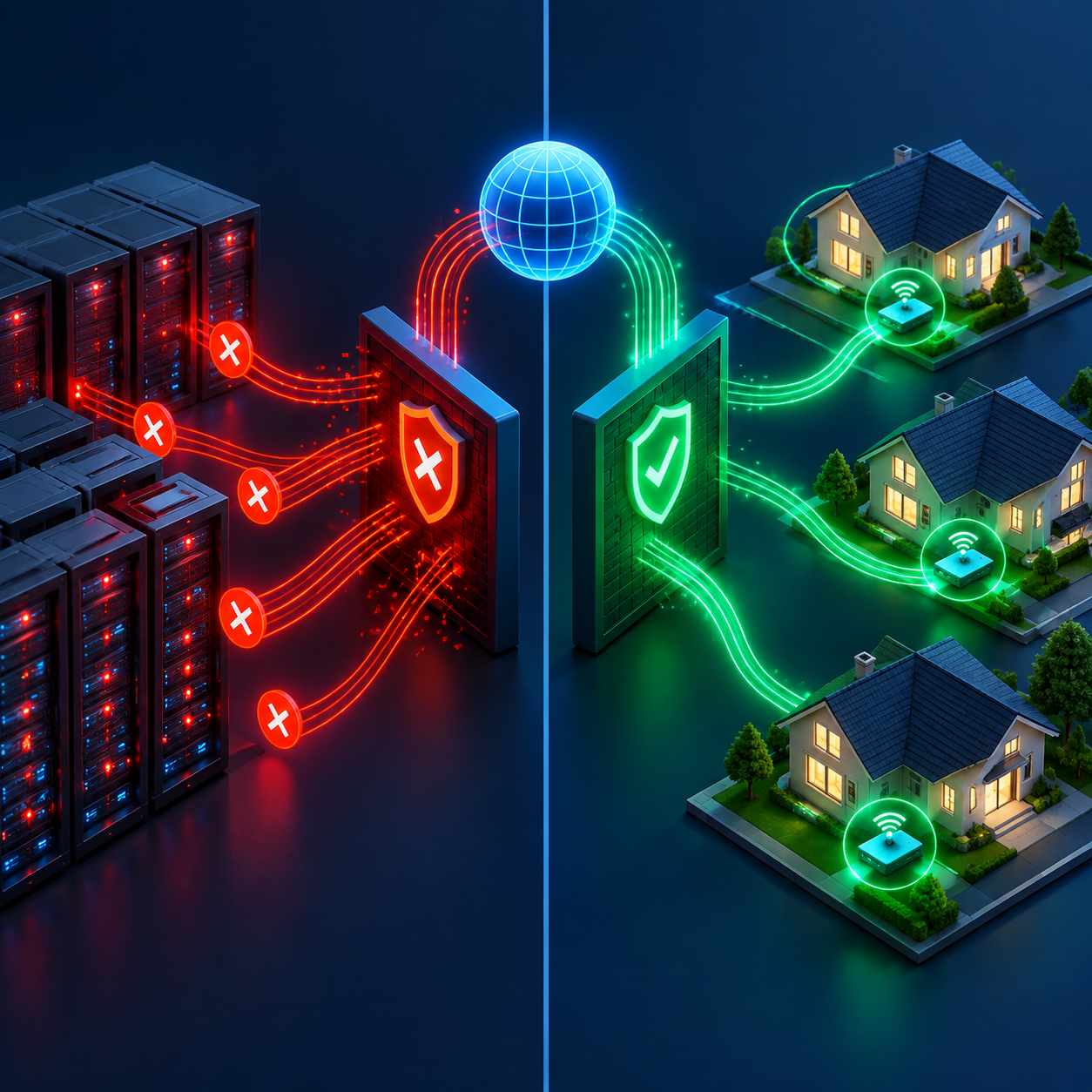 Residential proxies bypass cloaking filters by mimicking real consumer IP addresses, unlike easily flagged datacenter servers.
To clearly understand investment efficiency, let's compare the two common types of proxies used in ad fraud prevention:
- IP Origin: Datacenter Proxies use IPs from cloud servers (AWS, DigitalOcean); Residential Proxies use IPs from real consumer devices (ISPs).
- Anonymity Level: Datacenter Proxies have Medium to Low anonymity (easily detected); Residential Proxies have Extremely High anonymity (nearly undetectable).
- Geo-Targeting: Datacenter Proxies are limited to country or major city levels; Residential Proxies provide granularity down to small cities, ISPs, and ZIP codes.
- Block Rate: Datacenter Proxies have a high block rate when scanning at scale; Residential Proxies have a very low block rate thanks to automatic IP rotation.
- Ad Fraud Cost Optimization: Datacenter Proxies easily get skewed results due to cloaking; Residential Proxies deliver 100% accurate data, protecting budgets more effectively.
Implementation Process of Residential Proxies for Ad Verification Campaigns
 Implementing residential proxies requires connecting clean IP pools with automated scanning tools to continuously verify global ad campaigns.
To implement a residential proxy marketing solution effectively, businesses and agencies should adopt a standardized 4-step process:
Step 1: Define Objectives and Audit Scope
Clarify campaign audit goals: Geo-display checks, competitor monitoring, click fraud detection, or brand safety verification? Based on this, determine the number of target locations to scan and the audit frequency.
Step 2: Choose a Reputable Proxy Provider
Select an ad verification proxy provider with a sufficiently large IP pool (millions of global IPs), support for automatic IP rotation (Rotating Proxies) or flexible sticky sessions, and commitments to clean IP sources and compliance with data privacy regulations.
Step 3: Integrate into Automation Tools
Connect residential IPs to specialized ad testing software or browser automation frameworks like Selenium, Puppeteer, or Playwright. This allows the system to automatically capture screenshots, analyze URL flows, and log impression data 24/7.
Step 4: Analyze Data and Take Action Against Fraud
Aggregate data collected from the proxy system and compare it with reports from Ad Networks. When discrepancies are found (such as ads not displaying in committed placements or signs of click fraud), businesses can use this evidence to dispute payments or request contract compensation.
Conclusion
In an era of increasingly complex ad fraud, proactively preventing ad fraud is no longer optional—it is a mandatory requirement for any business operating global Digital Marketing campaigns. Utilizing an ad verification proxy—especially a residential proxy marketing solution—serves as a solid line of defense, helping enterprises safeguard financial resources, optimize ROI, and ensure international brand reputation. Making the right investment in a high-quality ad verification proxy system will deliver a distinct competitive edge and complete peace of mind for every digital marketing campaign.
Related articles
Ready for real proxies, not just the guide?
Buy Residential, ISP, Datacenter, or Mobile proxies — live in minutes.
View products